Background
The National Plan to End Violence against Women and Children 2022–2032 (the National Plan) says that we must elevate the voices of children and young people, recognise them as victim-survivors in their own right and establish trauma-informed supports and services that will meet their safety and recovery needs.
The Domestic, Family and Sexual Violence Commission (DFSV Commission) recognises that children and young people are often overlooked in our data, policy and service systems. To achieve our goal of ending violence against women and children in a generation, we must centre our focus on children and young people.
In May 2025, Australia’s National Research Organisation for Women’s Safety (ANROWS) held a conference focused on centring children and young people. Young advocates with lived experience of domestic, family and sexual violence (DFSV) came together to develop a collective statement calling for their voices to be included in the decisions that affect them. Following the conference, many also asked for the opportunity to speak directly with decision makers responsible for policies and services related to their safety and wellbeing.
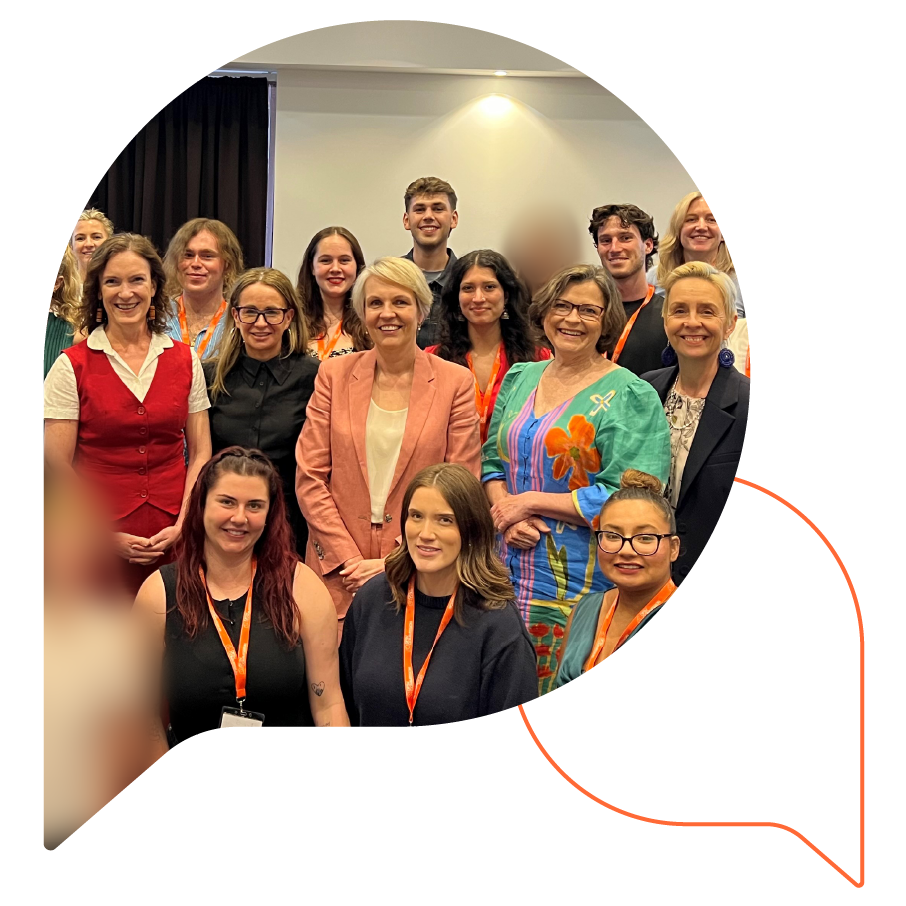
The DFSV Commission collaborated with ANROWS to enable this engagement, organising this Roundtable for advocates to meet directly with Minister Tanya Plibersek, Minister for Social Services, and Minister Ged Kearney, Assistant Minister for Social Services and Assistant Minister for Prevention of Family Violence.
The roundtable was co-designed with invited advocates. They helped shape the structure of the day and led facilitation and activities.
A note on the structure of this document: not all of the issues raised here have a proposed solution. The Commission recognises that proposing or developing solutions is not the sole responsibility of people with lived experience.
What we heard
Priority areas for action
Roundtable discussions identified these interconnected areas for urgent government action:
- Finding support
Children and young people of all ages should have accessible, easy-to-navigate and age-appropriate support options.
- Empowerment through education
Children and young people, their families, schools and communities need to be empowered to better prevent and respond to DFSV.
- Safe and accessible housing
Children and young people need safe and supportive housing options that ensure that they have a place to go to escape unsafe environments.
- Engaging with police
Children and young people’s interactions with police should not be scary or disempowering. Police must ensure that their engagement with all children and young people is safe and respectful.
- Family Court and the justice system
Children and young people need and want to be empowered to participate in family court and the justice system, and for their voices and experiences to be heard and considered.
- Systems transformation
Systems must utilise solutions that are codesigned and co-developed with children and young people and are embedded across communities, allowing for individualised, culturally-appropriate, accessible and sustainable prevention, support and recovery options.
Reflection on language
Providing a meaningful platform for the voices of people with lived experience of DFSV is vital for improving outcomes. Too often the voices of children and young people are dismissed or erased. It is critical that their voices be listened to, and acted upon.
People with lived experience of DFSV must be given the safe space and respect to communicate in the way that is true and authentic for them using the language that reflects themselves and their experiences.
In this report, we have done our best to reflect the words and experiences shared with us by the children and young people who participated in the Roundtable. Where possible, we have used participants’ own words or tried to reflect their language authentically. We have also summarised ideas and, by necessity, altered the language that expressed those ideas.
The Commission strives to find a balance between representing the participants’ words authentically and distilling information in a way that supports communication across governments and the DFSV sector.
With that in mind, we’d like to take this opportunity to honour the words of the children and young people advocates who gave their time so generously to contribute to this Roundtable.
Discussion
1. Finding Support
Children and young people of all ages should have accessible, easy-to-navigate and age-appropriate support options.
Most of the systems built to address DFSV were not designed for the specific needs of children and young people. Roundtable participants described difficulties finding and accessing support.
What young people told us:
- There is a service gap for young people who are too old for services for children and too young for services for adults. Young people aged between 15 and 18 and unaccompanied children and young people are often turned away from services.
- Even when there is a service targeted for young people, long waitlists can mean that a young person ages out of eligibility before receiving any care.
Young people’s ideas for next steps:
- Funding needs to be allocated to programs and services designed specifically for children and young people.
- Governments should investigate the potential scalability of existing programs and services such as Melbourne City Mission’s AMPLIFY program.
Fear of involving an abusive parent or guardian can discourage children and young people from attempting to access services.
What young people told us:
- Requiring parent or guardian permission to access a service can be a barrier to accessing that service.
- Mental health professionals can disclose information shared with them by a young person to their parent(s) or guardian(s) even when the young person asks them not to. This creates a risk that sensitive information will be shared with an abusive parent or guardian and discourages a young person seeking support.
- Government services can be difficult or impossible to access without parent or guardian cooperation. For example, one attendee was unable to access Centrelink benefits until the age of 22 because of eligibility requirements that she was not able to meet without parental income statements.
- Rigid rules about parent or guardian involvement or consent could be limiting, and there needs to be some recognition of the complexity and diversity of young people’s experiences and circumstances when designing support services for them.
Young people’s ideas for next steps:
- Allow young people under the age of 18 to be assessed as capable of making decisions for themselves, allowing them to access services that would otherwise be unavailable to them without parent or guardian permission and allowing them to participate in family court.
- This approach already exists in the medical space under what is known as the ‘Gillick competence’ provision where ‘mature minors’ can make their own decisions about their medical treatment.
Navigating the service system is difficult and confusing.
What young people told us:
- It can be difficult to find suitable support services in a system that generally takes a one-size-fits-all approach.
- The social media ban for people under the age of 16 may impact their ability to find and access help.
“You need professional knowledge to get the right help.”
Young people’s ideas for next steps:
- All supports and systems must be ready to work with children and young people using age-appropriate language and allowing children and young people to express themselves in their own way.
- Children and young people need dedicated case management and counselling to help them navigate the system and access supports that meet their individual needs.
The costs of supports such as counselling and medication are among the most significant barriers to long-term healing.
What young people told us:
“Why is healing something I have to afford?”
Young people’s ideas for next steps:
- To break the cycle of violence and support longterm safety and wellbeing, governments should invest in sustainable, long-term, individualised and culturally-appropriate recovery and healing support for children and young people affected by DFSV.
Colonisation, institutionalisation and ongoing trauma, as well as the outsized impact of climate change on the communities of the Torres Strait, continue to impact on Aboriginal and Torres Strait Islander communities and are contributors to DFSV.
What young people told us:
- Western approaches to prevention, response, and healing and recovery which do not consider these factors may cause further harm.
- Healing and recovery should recognise diverse cultural and personal journeys, and accommodate children and young people’s spiritual needs.
- Climate change will have a disproportionate effect on some communities, with some participants naming the loss of homes and cultural knowledge as being a major risk factor for future violence.
“I will go down with my island.”
The challenges of accessing services are multiplied in rural, regional and remote areas.
What young people told us:
- Fewer services are available and maintaining privacy while accessing them can be difficult in small communities where everyone knows everyone.
- When services are out of town, barriers to access are compounded for children and young people who may be unable to travel on their own.
2. Empowerment through education
Children and young people, their families, schools and communities need to be empowered to better prevent and respond to DFSV.
What young people told us:
- They felt that they and their community did not know enough about DFSV and respectful relationships.
“We learn about stranger danger, but what about those we know?”
Everyone has a part to play in preventing DFSV. Empowering children and young people and their communities to understand, prevent and respond to DFSV can be a powerful tool for prevention.
Young people’s ideas for next steps:
For children and young people:
- Consistent, comprehensive and up-to-date respectful relationships education (RRE) delivered across Australia.
- Education on broader social skills such as emotional regulation.
- Healthy masculinities education for young men and boys.
For teachers:
- Education on respectful relationships and DFSV can prompt students to disclose their experience of abuse to their teachers. Teachers need to be equipped to respond to a disclosure appropriately to ensure safety and maintain trust.
“Hear when children are telling us they are not safe!”
For schools:
- School counsellors and others in supporting roles must be trained to respond to DFSV and be prepared to speak directly to the child or young person about their experience. Empowering people in these roles to recognise and respond appropriately to disclosures of DFSV can be pivotal to early intervention.
“Meet us where we are.”
- Having age-appropriate resources available can help children and young people make sense of their experience and know where to find help.
- Experiencing DFSV can be highly stressful and overwhelming for children and participation in school activities can be impacted. Schools can play a role in their students’ support and recovery by listening to and making allowances for their needs. One young advocate told the Roundtable that he would have liked to have had a quiet space at his school for when he was feeling overwhelmed so that he could take a break before rejoining the learning environment.
For parents and guardians:
- While parents and guardians receive notice of RRE and information about the topics covered, attendees felt that parents and guardians could benefit from a more direct engagement in respectful relationships education.
For the community:
- Community education can be a powerful tool for prevention, particularly in culturally and linguistically diverse communities where individual intervention may not be culturally safe, appropriate or effective.
- Educating community leaders, health providers, sports coaches, and other members of the community can provide a support network for children and young people experiencing violence.
“Improve our village.”
- Providing options outside of the education environment also supports prevention. Initiatives such as youth mental health programs and young parent programs can provide more holistic supports for young people who may be at risk of experiencing DFSV.
3. Safe and accessible housing
Children and young people need safe and supportive housing that ensures that they have a place to go to escape unsafe environments.
Attendees described difficulties finding appropriate and safe housing options that provided an alternative to their unsafe home environments.
What young people told us:
- One attendee described refuge housing with an unsanitary kitchen and unsafe outdoor space (broken glass).
- Another attendee raised the issue that their disability support worker was not allowed to enter the refuge, thus making it impossible for them to stay.
- The service gap for 16 to 18-year-olds also impacts their housing options.
Young people’s ideas for next steps:
- Refuges and long-term housing supports need to be specifically designed and provided for young people, including those under 18 and those with disability.
4. Engaging with police
Children and young people’s interactions with police should not be scary or disempowering. Police must ensure that their engagement with all children and young people is safe and respectful.
Roundtable attendees described frightening and disempowering experiences with police, even as people with lived experience of DFSV.
What young people told us:
- One attendee told us that, when he was attending the police station at 7 years old, he found it scary, with officers nearby who were wearing guns. There was one officer that he found particularly scary, and he asked for the officer to not be in the room for his interview. This request was ignored and the child was forced to be in a small room with someone who frightened him.
- One attendee described their experience with police after running away from an unsafe home environment. They were picked up by police and returned to their home without the officers speaking directly to them or making any enquiries about their safety or wellbeing.
“No one spoke directly to me.”
- One attendee raised their concerns about corporal punishment, noting that there are laws against hitting animals, but not children. When a parent or guardian’s abusive behaviour towards their child can be interpreted as corporal punishment, it gives police a reason to not investigate further.
“They just assume they are a bratty little teenager.”
Young people’s ideas for next steps:
- Police must ensure that their engagement with all children and young people is appropriate. This should include consideration of the safety of young people who have run away from home.
5. Family court and the justice system
Children and young people need and want to be empowered to participate in family court and the justice system.
Attendees described how their exclusion from participating in court proceedings left them disempowered and compromised their safety.
What young people told us:
- One attendee described not being allowed to remain in court or to serve as a witness against his abusive parent because he was under 18. He was the key witness to the abuse, but his testimony was not considered in the matter.
- Independent Children’s Lawyers (ICLs) can be appointed in some federal family law cases to independently represent the best interests of the child. However, one attendee raised concerns about ICLs, which are echoed in studies on the ICL system and communication with the Commission, that ICLs rarely meet with or meaningfully consult the children and young people they are representing. As of May 2024, ICLs are now required to meet with the child or young person they are representing, however, there are ongoing concerns about the effectiveness of the reforms in ensuring that children and young people are adequately heard or empowered in the process.
“We need advocates in court.”
The costs of engaging with family court are significant and can be used to prolong abuse.
What young people told us:
- Engaging with the family courts can mean spending a significant amount of money. When the abusive parent has greater economic resources, they can use the system as a weapon of abuse, leaving the protective parent and their children in debt. This compounds the stress and trauma.
- One attendee described a situation where the court-appointed lawyer only had 40 minutes to review their case before appearing in court, putting the young person and their protective parent at a significant disadvantage to the abusive parent who could afford representation that was well-prepared for court.
The justice system and its processes can be an impediment to healing.
What young people told us:
- Participating in any form of court proceeding, particularly a criminal trial following sexual violence, is stressful, and potentially retraumatising.
- Some attendees told us that they felt that seeking justice was not mutually compatible with healing and that they had to make a choice between the two.
6. Systems transformation
Systems must utilise solutions that are co-designed and co-developed with children and young people and are embedded across communities, allowing for individualised, culturally-appropriate, accessible and sustainable prevention, support and recovery options.
Throughout the roundtable, attendees gave examples of the ways that the systems and services that were supposed to help them had let them down.
What young people told us:
- Children and young people need to be treated as people with lived experience of DFSV in their own right. This requires that they be respected and heard as individuals by the services that they engage with.
- The feelings, needs and interests of children and young people must be considered in every element of system and service design.
- Healthy, loving and pleasurable relationships, not just the absence of violence, should be the aim of all strategies aspiring to end gender-based violence.
“Change love from pain to pleasure.”
Young people’s ideas for next steps:
- Attendees called for not just systems change, but systems transformation that utilises solutions that are co-designed with children and young people and are embedded across communities, allowing for individualised, culturally-appropriate, accessible and sustainable prevention, support and recovery options.
The Commission will:
As part of its commitment to participants in the Roundtable, the Commission commits to ongoing transparency and accountability in its work relating to children and young people. This will be driven by key actions:
- When we give policy advice to government ministers or organisations, we will make sure we include, where relevant, the perspectives of children and young people, including the issues shared with us at the Roundtable.
- We will support this work by engaging directly and purposefully with young lived experience advocates to provide guidance on work to develop the Second Action Plan.
- Our team will look into the solutions and ideas proposed by Roundtable attendees to identify where existing or new policy can be developed.
- We will send this report to key stakeholders within governments.
- We will continue to deepen our understanding of the impact of family law and justice systems as they intersect with children and young people’s experience of domestic, family and sexual violence.
- We will review our work of engaging with children and young people and share our progress with government and the public in our 2026 Yearly Report to Parliament.
View the Summary Report
View media release
10 December 2025