Background
Aboriginal and Torres Strait Islander women and children are being murdered and disappeared at unacceptable rates across Australia. We all have a duty to take all preventative measures possible to address this violence.
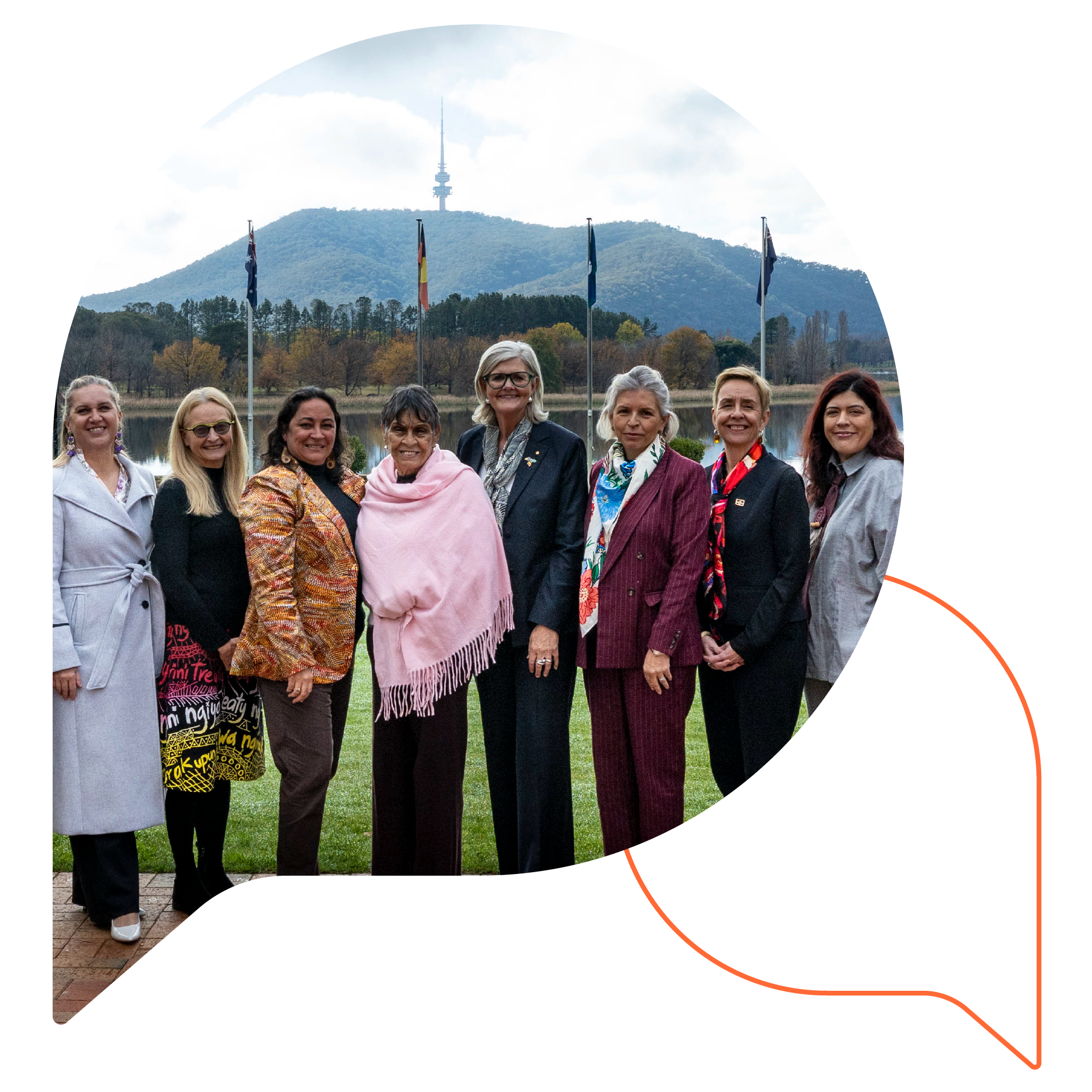
On 11 June 2026, Her Excellency the Honourable Ms Sam Mostyn AC, Governor-General of the Commonwealth of Australia hosted a national roundtable at Government House. Initiated by Dr Hannah McGlade, the roundtable was convened by the Aboriginal and Torres Strait Islander Social Justice Commissioner, Katie Kiss, and the Domestic, Family and Sexual Violence Commissioner, Micaela Cronin.
The roundtable brought together Aboriginal and Torres Strait Islander women leaders, representatives of affected families, advocates, legal experts, Aboriginal community-controlled organisations, and civil society stakeholders to consider Australia’s response to the ongoing crisis of Murdered and Missing (Disappeared) Aboriginal and Torres Strait Islander Women and Children (MMIWC). Government representatives were present to listen to the discussion.
Discussion
Those present honoured Aboriginal and Torres Strait Islander women and children who never came home, and paid tribute to the families who continue to pursue truth, justice and accountability for loved ones who were murdered, sexually assaulted, disappeared or died in unresolved circumstances, while carrying grief and sustaining those left behind.
The Seven Sisters Project was a key catalyst for the meeting and centres on advocacy through a series of United Nations Committee on the Elimination of Discrimination against Women (CEDAW) cases concerning Aboriginal women and their families. The project highlights the impacts of wrongful incarceration, homicide, and inadequate or discriminatory justice system responses, as well as broader systemic and societal failures. Members discussed how these issues have been examined in research on Indigenous femicide and MMIWC, including work that frames such experiences within the broader context of systemic and state-based violence.
Participants shared:
- the significant contributions, leadership and advocacy of Aboriginal and Torres Strait Islander women over many decades, including those who have brought national and international attention to system failures affecting Aboriginal and Torres Strait Islander women and children.
- seeking justice for Aboriginal and Torres Strait Islander women and children is often lonely and many feel unsupported, consideration should be given to establishing mechanisms that can support leaders, front line workers and their families, as well as the families of those who experience harm.
- the enduring relevance of Inquiries into violence against women across Australia, starting with the1986 Women’s Business Report, the 1991 Inquiry into Racist Violence, the findings of the 2024 Senate Legal and Constitutional Affairs References Committee Inquiry into Missing and Murdered First Nations Women and Children (the Senate Inquiry), Coroners reports, the work of Aboriginal and Torres Strait Islander women’s organisations, and advocacy before international human rights mechanisms.
- the significant contributions, leadership and advocacy of Aboriginal and Torres Strait Islander women over many decades, including those who have brought national and international attention to system failures affecting Aboriginal and Torres Strait Islander women and children, noting the work under the multi-year Wiyi Yani U Thangani (Women’s Voices) as a model for elevating the voices of First Nations women and children.
- the Missing and murdered First Nations women and children Senate Inquiry, 2024 brought to light the national crisis of MMIWC, documenting extensive evidence and the experiences of families and communities, exposed systemic failures across policing, justice, child protection, and service systems, and provided a national platform for truth-telling and coordinated action.
- the consultations for the first dedicated Aboriginal and Torres Strait Islander National Plan, Our Ways – Strong Ways – Our Voices, also highlighted systemic discrimination and the need for investment into Aboriginal and Torres Strait Islander-led community-based responses.
Participants expressed grave concern about the persistent lack of access to justice, both domestically and internationally, for Aboriginal and Torres Strait Islander women and families seeking accountability.
They emphasised that inquiry recommendations remain only partially implemented and require sustained oversight and public accountability.
The roundtable considered the implementation of existing national strategies, including Our Ways – Strong Ways – Our Voices: National Aboriginal and Torres Strait Islander Plan to End Family, Domestic and Sexual Violence 2026–2036, launched in February this year, and the Aboriginal and Torres Strait Islander Action Plan under the National Plan to End Violence against Women and Children 2022–2032.
Participants recognised these initiatives as important foundations for reform. They also agreed that MMIWC cannot be understood or addressed solely through the lens of domestic, family and sexual violence (DFSV).
While domestic and family violence is a significant driver of deaths and disappearances, Aboriginal and Torres Strait Islander women and children also face heightened risks from racism, systemic neglect, institutional violence, child removal, homelessness, incarceration, exploitation, unsafe service responses and justice system failures. Women and children with disability are particularly at risk.
In Australia, it is unquestionable that MMIWC constitutes a national human rights crisis.
It is estimated that between July 1989 and June 2023, at least 476 Aboriginal and Torres Strait Islander women, gender diverse people including sistergirls, were victims of homicide. Yet the full scale of the crisis remains obscured by significant data gaps that limit visibility and effective responses.
Participants emphasised the importance of applying a gender lens to Indigenous affairs to advance gender equality and strengthen responses to violence. Participants noted that family violence against Aboriginal and Torres Strait Islander women should be recognised as a gendered societal issue rather than being framed solely as an Aboriginal and Torres Strait Islander community issue, as such framing can reinforce harmful stereotypes. It was highlighted that Aboriginal and Torres Strait Islander women and children experience violence at disproportionately higher rates than non-Indigenous women and children, and that effective responses require a gender-responsive approach. Participants also noted ongoing gender bias within Indigenous affairs, including disparities in funding and investment, underscoring the need for more equitable and gender-responsive policy, program design and resource allocation.
Access to justice is a fundamental human right that is too often denied to Aboriginal and Torres Strait Islander women and children in Australia. We note that the Seven Sisters UNCEDAW cases were rejected on the view of the Committee on the Elimination of Discrimination against Women that all domestic avenues/remedies had not yet been exhausted. Participants raised concerns about the absence of accessible and appropriate complaints processes and domestic remedies and urge Australia to ensure that Aboriginal and Torres Strait Islander women can effectively access justice under the Optional Protocol. In the 25 years since ratification, no cases from Australia have been accepted, and the rejection of MMIWC-related matters raises serious concerns that must be addressed by relevant Australian Government agencies and the UNCEDAW.
Drawing on the substantial body of existing evidence, Australia’s response to MMIWC must centre truth, justice, accountability, healing and self-determination. It must recognise intersecting forms of violence and address the broader conditions that place Aboriginal and Torres Strait Islander women and children at risk.
Every Aboriginal and Torres Strait Islander woman and child has the right to live free from violence, to be safe within their family, community and institutions, and to have their life valued.
Families, advocates, researchers and Aboriginal and Torres Strait Islander women have repeatedly identified both the causes of, and solutions to, this crisis. The task before governments is not to determine what must be done, but to demonstrate the sustained commitment required to do it.
Key themes
MMIWC as a National Human Rights Crisis
Missing and murdered Aboriginal and Torres Strait Islander women and children is a profound national crisis that requires sustained and coordinated attention, and it must be understood as a human rights issue that intersects with racial justice, gendered violence, child protection, and self-determination, while also aligning with international obligations such as the United Nations Declaration on the Rights of Indigenous Peoples (UNDRIP), Convention on the Elimination of All Forms of Discrimination against Women (CEDAW), International Convention on the Elimination of All Forms of Racial Discrimination (CERD) and the Convention on the Rights of the Child (CRC).
Systemic Racism, Colonisation, and Structural Drivers of Harm
Violence against Aboriginal and Torres Strait Islander women and children is driven by the ongoing impacts of colonisation, intergenerational trauma, and structural inequality, and is compounded by systemic racism and harmful stereotypes across institutions, which contribute to dehumanisation, reduced protection, and poorer outcomes, constituting forms of racial violence that require systemic reform.
Systems abuse by perpetrators and systemic racism in responses compounds the risk of death, violence, child removal, criminalisation, incarceration and other forms of significant disadvantage for Aboriginal and Torres Strait Islander women.
Failures in Justice, Policing, and Institutional Responses
There are persistent failures across justice, policing, and service systems, including gaps between policy commitments and on-the-ground practice, misidentification of victim-survivors as perpetrators (including from racial profiling and stereotyping in the justice system), inadequate investigations, and unsafe or neglectful institutional responses, all of which highlight the need for stronger safeguards, oversight, accountability, and culturally informed reform.
Accountability, Implementation, and National Coordination
There is an ongoing failure to implement the recommendations of past inquiries and reviews, including death reviews, demonstrating the need for stronger national coordination, including clear oversight mechanisms, independent accountability structures, transparent tracking and reporting, and the establishment of a dedicated national framework on MMIWC aligned with Closing the Gap priorities.
Sustainable Investment in Community-Led, Culturally Safe Responses
Current funding arrangements are often short-term, insufficient, and lacking transparency, which undermines frontline service delivery, and there is a clear need for long-term, equitable investment that prioritises Aboriginal Community-Controlled Organisations and supports prevention, healing, and culturally safe, community-led responses rather than predominantly punitive approaches.
Centring Families, Data, and First Nations Leadership
Families play a critical role in seeking truth, justice, and accountability but are often unsupported and excluded, highlighting the need to properly recognise and resource their involvement, while also improving data collection, consistency, and transparency, and ensuring that First Nations voices, leadership, and self-determination are central to all responses alongside a stronger focus on public visibility and truth-telling.
Calls to Action
1. National Cabinet provide a community update on actions taken to address MMIWC since 2024
On 6 September 2024, National Cabinet committed to “maintaining a central focus on missing and murdered First Nations women and children and agreed that all government commitments on gender-based violence must explicitly consider the needs and experiences of First Nations people and be delivered in genuine partnership with First Nations communities.”
We call for a status update be provided on progress in relation to the Australian Government response to the 2024 Senate Committee Inquiry on the Missing and Murdered First Nations Women and Children.
2. Murdered and Missing (Disappeared), Aboriginal and Torres Strait Islander Women and Children addressed as a key priority across government
Recognising the different and intersecting issues between family, domestic and sexual violence and murdered and missing women and children – that consideration of this issue be included as part of the national consultations underway to inform the second action plans under the four National Frameworks.
We call on the Department of Social Services to lead an audit of recommendations from Inquiries that address the issue of MMIWC, and that supports a coordinated actioning and response to recommendations made.
We call on all state and territory jurisdictions to engage on this issue through relevant national Ministerial Councils, and to make MMIWC an agenda item at their next Council meeting, including the Standing Council of Attorneys General, the Police Ministers Council, Women and Women’s Safety Ministerial Council, and the Joint Council on Closing the Gap.
3. Improve National Data Collection and Transparency
In accordance with Priority Reform Four under the National Agreement on Closing the Gap, Shared Access to Data and Information at a Regional Level, we call on the Data Policy Partnership to strengthen existing data systems and processes, and to lead the establishment of nationally consistent data systems where gaps remain, to ensure comprehensive, accessible and culturally informed data relating to violence, disappearances and deaths affecting Aboriginal and Torres Strait Islander women and children.
This should include data systems that:
- accurately tracks the rates of violence experienced by Aboriginal and Torres Strait Islander Women, as per Target 13 of Closing the Gap
- accurately identify Aboriginal and Torres Strait Islander status
- track missing persons cases and outcomes
- monitor homicide investigations and unresolved deaths
- identify institutional contact preceding deaths and disappearances
- improve data access pathways and increased visibility related to MMIWC and inter-related Closing the Gap targets support evidence-based policy development
- ensures Aboriginal Community Controlled Organisations (ACCOs) are sufficiently resourced to undertake the collection, analysis and evaluation of their own data
- leverages the critical infrastructure that the Death Review Network already provides for monitoring homicide investigations, unresolved deaths, and institutional contact preceding deaths and disappearances; and strengthen these existing mechanisms to improve national consistency, transparency, data sharing and accountability, while reducing duplication and informing the development of new data systems where gaps exist
4. Establish Mechanisms of Remembrance and Recognition
We call on the Prime Minister’s Office through the Office for Women to lead the establishment of culturally appropriate national mechanisms that honour and remember Aboriginal and Torres Strait Islander women and children who have been murdered or disappeared, and that raise awareness of MMIWC as a national human rights crisis. This must form part of a sustained, long-term national strategy, informed by the demonstrated effectiveness of community-led initiatives and campaigns delivered by specialist Aboriginal and Torres Strait Islander family violence services across Australia. Mechanisms must not be progressed in isolation from the broader reform agenda, as a standalone approach would risk a symbolic rather than substantive response to the systemic drivers of violence and inequality.
Download the Roundtable Report
View Media Release
9 July 2026