I'm very pleased to be here. Thank you for the invitation to speak.
I want to begin by acknowledging that we are meeting today on Ngunnawal Country.
I started the day very early this morning with the Djirra and Sisters in Spirit march for the commencement of the 16 Days of Activism. It was a real privilege to be there, to be welcomed to Country and to hear about the incredible work and leadership they provide. It was also a powerful reminder of the disproportionate harm experienced by Aboriginal and Torres Strait Islander women and communities in this country, and of the fact that the solutions lie within Aboriginal and Torres Strait Islander organisations. I know that is something many people in this room understand deeply. It was a privilege to begin the day there.
I also want to acknowledge the lived experience in this room. The Commission's yearly report has been deeply informed by what we have heard over the past four years. I have now been in this role for four years, and I particularly want to acknowledge Tiffani, who was a member of our inaugural Lived Experience Advisory Council.
Listening to the thoughtful and insightful questions you asked earlier, Tiff, made me think that perhaps we should begin every conference session with questions. It would help ensure I address the issues that matter most to you. Hearing your reflections today made me rethink parts of my speech, so thank you for your leadership.
I also want to apologise for arriving late. It has been one of those days. As many of you know, the beginning of the 16 Days of Activism is incredibly busy, and this is the fourth event I have attended today. I have always valued being part of this conference and have tried, whenever possible, to be here for the full event because I learn so much every time.
Before coming here, I was listening to Commissioner Sue-Anne Hunter, Australia's inaugural Aboriginal and Torres Strait Islander Social Justice Commissioner, speaking about her work and the urgent challenges we need to confront regarding the experiences of Aboriginal and Torres Strait Islander children in this country. It was a powerful and important address.
So, my apologies for arriving late. Like many of you, I am finding there are simply too many important conversations happening at once. I also want to acknowledge that you have chosen to be here and committed your time to this work. Thank you for everything you do, every day.
One of the things I want to talk about today is the progress we have made. That progress has been driven by the service providers in this room who have advocated tirelessly, by researchers and academics who have dedicated themselves to understanding these issues, and by people with lived experience whose advocacy continues to shape reform.
Heather, thank you for your presentation earlier. It was incredibly thought-provoking. One of the things that struck me most was your emphasis on detail and understanding. We can speak in broad terms about coercive control and other concepts, but the detail matters. Understanding what people experience everyday matters. Being able to explain those experiences clearly matters. We are now seeing coercive control reflected in legislation, but legislation alone is not enough. We also need the tools, knowledge and understanding to recognise it and respond appropriately.
I also want to acknowledge the extraordinary contribution of lived experience advocates. We have seen profound change because of their advocacy. In particular, I want to acknowledge Trees and the work of What's Forward. Some of the legislative changes we have seen this year, changes that will make a genuine difference in people's lives, have come about because advocates identified specific, practical reforms that were needed.
Often, the reforms that matter most are not the headline-grabbing election commitments. They are things like better judicial training, embedding education into both foundational and ongoing professional development, and making small but meaningful changes to systems and processes. These are the things we know make a difference.
So, that is a long way of saying thank you to everyone in this room.
The thing that Cat talked about was our yearly report to Parliament. One of the things I think about a lot in this role is how we measure change and success. How do we measure where we’re going?
Sue-Anne was asked a question about child poverty, and her answer was, “Well, how do we know? Because we don’t measure it.”
There are so many things that we don’t measure. When I started in this role, one of the first things I did was ask a range of people, “What is this job? What is it that you need me to do? If I’ve done a good job in five years’ time, what will be different for you as service providers and leaders in the sector?”
Somebody very confidently said to me, “Well, you will establish baselines. You will establish baselines from which we can measure change and progress.”
I remember thinking, “Great, that sounds like a really concrete, practical thing to do.”
We all know that is an incredibly hard task. There are so many factors that affect why we don’t know the rates of domestic, family and sexual violence. It isn’t safe for everybody to put up their hand and report. We can’t just rely on police reporting.
And the question of whether increased police reporting is a good thing is not straightforward. In some cases it probably is. In other cases it might not be. It’s not necessarily a good thing in and of itself. It potentially reflects increased prevalence, and I think many of us have real concerns about increasing prevalence in some spaces, particularly around sexual violence, but not only sexual violence.
So we can’t just look at one piece of data. We can’t just look at self-reporting in surveys. No matter how robust the surveys run by the ABS are, they are still self-reported surveys conducted in environments where not everybody is going to feel safe sharing their experiences.
Not everybody is going to have the language. Not everybody is going to know that what they are experiencing isn’t normal and is against the law. They won’t necessarily know how to tell that story because it’s what they’ve grown up with, it’s what’s normal, and it’s what they accept.
So, while establishing baselines sounds like a nice, easy KPI, it is incredibly difficult. But it is also really important because my assessment is that we have made some very real progress.
As Heather said, and as David said before, we are seeing significant legislative reform. We are seeing increased investment. We are seeing changes in language.
I started working in a women’s refuge more than 35 years ago. I worked in women’s refuges for about seven years, and I worked in frontline sexual violence roles for about seven or eight years. The language is very different. The services are very different. We are challenging our systems in ways that we were not able to challenge them then.
But the other thing I would say about progress is that it is uneven and unequal. We need to recognise and say both of those things at the same time.
We have to acknowledge the hard work that you have all contributed to in terms of that progress and change. We have to recognise that change is possible. But fundamentally, we still have a country in which the people who are most disproportionately impacted by domestic, family and sexual violence are also the people most underserved by our system. Not by you, but by the level of funding that goes directly to services for them.
They are the people most likely to be harmed by our systems, to have their children removed, and to be misidentified as the primary aggressor. They are also the people who are least visible in our data and our research.
Again, that is not due to the efforts of people in this room. It is about what gets funded and what gets counted.
Our major datasets still do not adequately collect or reflect the experiences of women living in remote communities, women in institutions, women in prisons, or women in aged care.
We also do not yet adequately understand the experiences of children because we do not really have a system that talks to children properly and listens to them.
So, while we have made progress, we still face significant challenges for those people who are least well served and most disproportionately harmed.
The other thing I would say, and again it’s one of the points we make in our yearly report, is that we know a lot. We know an awful lot.
Over the past couple of years, we’ve done some work, and we’re doing more intensive work that we’ll be sharing shortly, looking at more than 100 major inquiries since 2010. That includes royal commissions in many jurisdictions, major inquiries, Tasmania’s Commission of Inquiry into Institutional Child Sexual Abuse, Queensland’s two major inquiries, death reviews, large coronial inquests and ALRC inquiries.
We have spent a great deal of time asking questions and examining the problem. At our current count, and we’re still doing more work on this, there have been more than 4,500 recommendations arising from those inquiries.
Now, I would still say that while we know a lot, it’s not good enough to simply say we know everything and just need to implement. There are still significant gaps in what we know.
We do not know enough about the perpetration of sexual violence, particularly where it differs from sexual violence that occurs outside the context of domestic, family and sexual violence. We have some very good research underway, but it is still early days. We do not know enough about the perpetration of sexual violence and, therefore, we do not know enough about prevention.
Yesterday morning, the first reports from the prevention projects funded by DSS and analysed by The Cave were launched. What they tell us is really interesting.
One of the things that stood out to me was a story shared by one of the researchers about a relatively short, targeted intervention being delivered in universities. One of the things they said was: "What we recognised is that attitudes didn’t need to shift a great deal. People do know what’s going on. What they needed help with, and where we saw change, was behaviour and intervention."
One of the stories involved a young woman living on campus who attended a training session. The program ran over several sessions a few weeks apart. Between two of those sessions, she was at a pub with friends. One of her friends became very intoxicated, and a young man was trying to take her away with him. The young woman intervened and said, "No, you’re coming home with me."
I don’t know whether anyone else almost cries hearing a story like that, but it really hit me in the chest. That young woman described an intervention that probably saved her friend from significant harm.
That is a pretty extraordinary and immediate prevention outcome from that program.
So, we still have a lot more to learn about prevention, particularly in relation to sexual violence.
I would also say that we still have a lot to learn about the people who are most disproportionately harmed. You all know who I’m talking about. I’m talking about Aboriginal and Torres Strait Islander women and communities. I’m talking about LGBTIQ+ communities. I’m talking about women living with disability, older women, children, and migrants and refugees living on precarious visas. These are the people most harmed in our communities, and we still need to know more about their experiences.
So, the story is complex and nuanced. We have examined the problem extensively. One of the biggest challenges we face now is implementation and accountability, accountability for those recommendations.
Another finding from our current work on those 4,500 recommendations is that, while further analysis is underway, our assessment at this stage is that for about half of them there is no publicly available information about what was done with them. We don’t know whether they were accepted, implemented or funded. They may very well have been, but the challenge is that this information is not being shared in a way that allows us all to learn from it.
So, we have an implementation challenge.
We also continue to recommend, as we have every year for the past four years, secure, ongoing funding for organisations. We need stable workforces. We need the ability to build capability and knowledge across those workforces. And we need systems that allow us to share learning over time.
So, while we know a lot, we still have significant implementation gaps.
We have seen progress, but that progress remains uneven and unequal.
The other thing I would say is that we have built a system largely on the back of voluntary community movements that have provided services, care and safety within communities.
These are movements that have emerged in local communities. Women's refuges developed because communities knew there was nowhere safe for someone to go. Whether communities are place-based or identity-based, whether it's LGBTIQ+ communities creating safe places for people to go and someone to talk to, these services have largely grown from the voluntary efforts of people within those communities. Those efforts have been led, carried and sustained by community members themselves.
There are still services, and I am sure many people in this room, doing work that is voluntary, unfunded and additional to the work they are funded to do.
What that means, though, is that our system has largely been designed around crisis response and incident-based response. It is designed to respond to one-off incidents.
Police responses are a good example. Police funding represents one of the largest components of the response funding counted within our response to domestic, family and sexual violence. Police work has developed around responding to crisis incidents, not identifying patterns, not supporting people at the early signs of those patterns and not necessarily responding to behaviours before they become criminal offences.
As our understanding of coercive control evolves, most of our systems are not resourced to do that work. They do not have the tools or the capability to do it effectively.
So, we are trying to make some really significant changes to the way our services have developed.
Another point Commissioner Hunter made earlier was the importance of shifting from crisis response to intervening as early as possible, at every opportunity.
Again, I want to acknowledge the effort many of you have made over the years. Across those more than 100 inquiries, many of you have written submissions, thought carefully about the questions being asked and made significant efforts to inform decision-makers.
We have gone through that process again this year with the second Action Plan, and this is a really important moment.
I want to thank everyone who contributed. I sat in many of those second Action Plan consultations, and I was incredibly impressed by the sophistication of what people were sharing about where we have come from, what we know and what needs to happen next.
One message came through consistently in every one of those conversations: intervene earlier.
No health system would say, "We're going to focus on early intervention and preventing cancer and other health issues, so we're going to stop funding ambulances and emergency departments."
Of course, you have to do both.
Of course, we have to continue caring for people once they have been harmed.
At the same time, services are at breaking point responding to demand.
I was in Ballarat last week, where they have been implementing the saturation model. When I visited a year ago, people were deeply concerned. They were saying, "This is great, we're talking more about prevention in our community, but what happens when people start putting their hand up and recognising they need support when we're already overloaded and unable to meet demand?"
I remembered that conversation when I returned last week because that's exactly what they are seeing: increases in reports, increases in demand and need, and more people putting their hand up and saying, "I need some help."
The services there were stretched to their limits, just as I know many of you are.
So, we need to think about how we do all of those things at the same time.
One of the things we have consistently called for in our yearly reports, and every time I have the opportunity to speak about this, is that we have to be ambitious. We have to invest at a scale that matches the scale of the problem. And we have to believe that change is possible.
We have to be ambitious and brave about what needs to happen if we are going to intervene earlier.
Heather, you touched on this and have spoken about it over the past few years. Intervening earlier requires coordination and collaboration, deep coordination and collaboration.
It requires drug and alcohol services working closely with specialist family violence services. It requires GPs to have strong referral networks they can connect with when they need to. It requires teachers having the time and support to identify early warning signs and recognise not only those signs, but opportunities to support change, opportunities where pathways can be informed, shaped and changed.
Many of you in this room have done incredibly important work in this area. You have asked: how do we recognise those pathways? How do we identify the moments when intervention is possible? And how do we provide the right services at those points?
But it is not easy.
It is not easy to get different systems and silos working together. At the same time, I think there is a phenomenal amount of good work happening in this space.
Another point I would make when we say we know a lot is that we already have a great deal of positive reform underway.
I came in late to David Pringle’s presentation, but there is a phenomenal amount of important reform happening in the family courts. We need to stay the course and make sure those reforms are properly resourced before we start making judgments about whether they are working.
Sometimes we move too quickly to deciding whether something has succeeded or failed.
You all know what that feels like. You hear things like, “Well, hang on, you didn’t actually fund us to do that properly. We didn’t have much time.” Or, “We only found out we had funding for this piece of work at the last minute. There was no funding for evaluation. We had to recruit staff quickly because it was a pilot, and then those staff had to leave because they needed secure employment and families to support.”
That is another reason why it is important to recognise and celebrate progress. We need to acknowledge that there are things that have worked.
We have done lots of things that have worked. Many of you have led changes that have improved practice.
When I visit services and see the depth, sophistication, wisdom and expertise that exists across the sector, it is very different from what I saw 30 years ago when I started this work. The change is quite dramatic. We did okay back then, but what is happening now is far more sophisticated.
So, some reforms need to be properly funded. We need to stay the course. We need to evaluate them and learn from them.
Other reforms require us to make brave decisions about what is not working and where funding needs to shift.
The other thing I would say is that we need to recognise that we are living through a really difficult time.
What worries me a great deal is that we have a generation we have failed in so many respects.
I was at the eSafety Commissioner’s Safety Online Summit on Monday, and when we think about online harm and what has happened to this generation of children, it has happened incredibly quickly.
We had no guardrails. We didn’t educate anyone, including the adults and parents in their lives.
I remember walking into a room and seeing my daughter, who was about four years old, sitting on her dad’s lap and typing into a computer. She was searching something like "young girls love puppies, ponies". I was absolutely horrified by what appeared on the screen. All I could do was get her away from that computer as quickly as possible.
So, we haven’t protected young people, and we haven’t educated them. Now we are making significant changes, but those changes may also have unintended consequences. They may create new harms, particularly for those who are already disproportionately harmed and least well served.
Often, these are the young people who go online looking for connection, looking for their community and looking for answers to questions they may not feel safe asking anywhere else.
They are also the generation that has grown up through COVID. They are seeing rates of violence and extremism increase. They are facing existential concerns about the future, concerns about artificial intelligence, the possibility of global conflict and the pressures of the cost of living.
And yet, despite all of that, I am actually very hopeful about this generation.
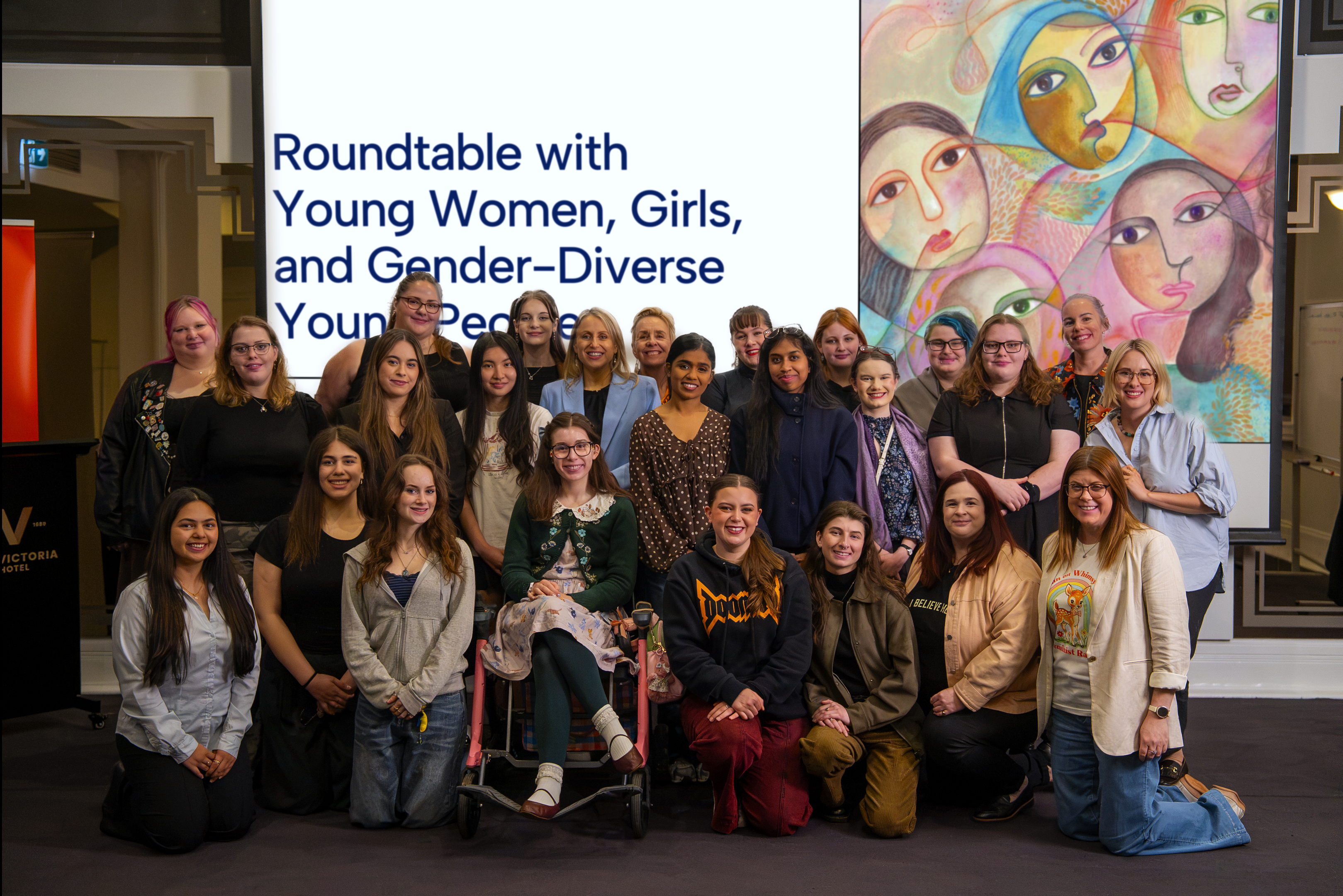
Last Tuesday, we held a roundtable with girls and young women. At the same time as I am deeply concerned about policy approaches that criminalise young people’s behaviour and lock them up, despite there being no evidence that this does anything other than cause harm, those young women gave me enormous hope.
They were incredibly thoughtful and nuanced in how they spoke about what is happening in their lives. They were clear and sophisticated about what they think will work. They talked about intersectionality and the need to recognise diverse experiences. They spoke about racialised experiences and the realities of living in remote communities in ways that I know I could not have done at their age.
They give me enormous hope.
And we need to invest in them and listen to them. We need to listen deeply to their voices.
I heard a quote on a podcast some time ago that has really stayed with me: "We need to listen deeply enough that we are changed by what we hear."
That is not the way everybody listens. But it is the way many of you have learned to listen, and it is the way many services and practitioners learn to listen.
I remember having to learn that lesson myself. When someone was in crisis and telling me about what had happened to them, I often felt frightened by what I was hearing. But I learned that my role was not to react to my own fear. My role was to sit, listen and be present.
What felt shocking and overwhelming to me was often something that person had lived through many times before.
I needed to be calm enough to sit with them, be present with them and truly listen.
So, we need to be listening deeply. We need to have hope. We need to believe that change is possible, and we need to be ambitious about the level of that change.
The last thing I would say is that we also need to be realistic about what is possible.
I want everyone here to recognise that we are all going on a journey with this next Action Plan. It is a five-year Action Plan. I am very confident, and those of you who were in the room with Minister Plibersek and the Attorney-General will know, that they are listening deeply and advocating strongly for the things that have been recommended. They are not going to secure all of it, and it will not be for lack of trying.
One of the recommendations we made in our yearly report is that the five-year Action Plan cannot be a set-and-forget exercise. It cannot be a case of developing a five-year plan and then measuring it at the end to see how we have gone.
It needs to be iterative. It needs to evolve every year. It needs to listen to all of you and ask: "We implemented this, so how is it going? What is changing? What are you seeing on the ground?"
One of the things I am interested in exploring next year is what changes people are seeing now that there is much greater recognition of coercive control and now that coercive control is being legislated.
What is actually changing?
Yes, legislation is changing, but how are practices changing? How is culture changing? Are police officers approaching situations differently when they attend incidents and ask questions? How is that shaping responses?
What is the data telling us about the reform agendas underway in the family courts and other systems where there has been significant reform? What are we hearing and learning about those changes? And how do we continue to adapt in response?
These are the kinds of questions I think about. One of the privileges the Commission has is the opportunity to provide a yearly report to Parliament. That gives us the chance each year to take stock, test our assumptions and sense-check what is happening.
We want to continue working with all of you on what goes into next year's report.
Once the second Action Plan is launched by government, we will move into a new phase of work. We identified several persistent issues that continue to require attention for different reasons.
Sexual violence is one of them.
Children and young people, and how we think about children and young people, is another.
Men and boys, and how we think about the perpetration of violence and harm, is another.
Family law systems, and how reform is progressing within those systems and what more may be needed, is another.
These are areas we believe require continued attention. That is not to say we have not seen progress. As I have said, we have. But these are issues we will continue to focus on, and we want to work with all of you to understand what we are hearing and what we should be saying about them.
So, consider this a very open invitation.
We will be meeting with services around the country as we begin planning engagement for next year's yearly report. I am also interested in thinking early about the best ways to do that engagement.
One area I am particularly interested in, and this will be the last thing I talk about, is the differences across jurisdictions.
One of the challenges of our federation is the division of responsibilities and powers between the Commonwealth and the states and territories.
We do not always recognise just how different Australia is across jurisdictions.
We would not expect France and England to take exactly the same approach to policy issues because we recognise they are fundamentally different. In the same way, Tasmania, the Northern Territory, Queensland and Western Australia are all very different.
It is not just that the language is different. It is not simply that the terminology used in legislation about sexual violence differs across jurisdictions.
The views that informed those laws were different when they were developed, and the contexts remain different.
What "remote" means in the Northern Territory is very different from what it means in Tasmania. But both experiences are real, and both have significant impacts on people's lives.
If you live on an island off Tasmania and cannot easily leave, your isolation is real. It may involve shorter distances than those experienced in remote parts of the Northern Territory, but the impact can be just as significant.
So, we need to understand those different contexts.
We cannot take a one-size-fits-all approach to how we fund services, allocate resources or understand what is happening in communities across Australia.
We still have work to do in helping people hold on to hope and believe that change is possible.
I know it is possible because I have seen the outcomes of your work. I have seen the impact your work has on people's lives every day.
We can do this.
We need the enabling infrastructure, the resources and the policy framework to support it. And I believe we are at a moment where we have a genuine opportunity to continue driving that change together.
So, thank you very much for all of your work.