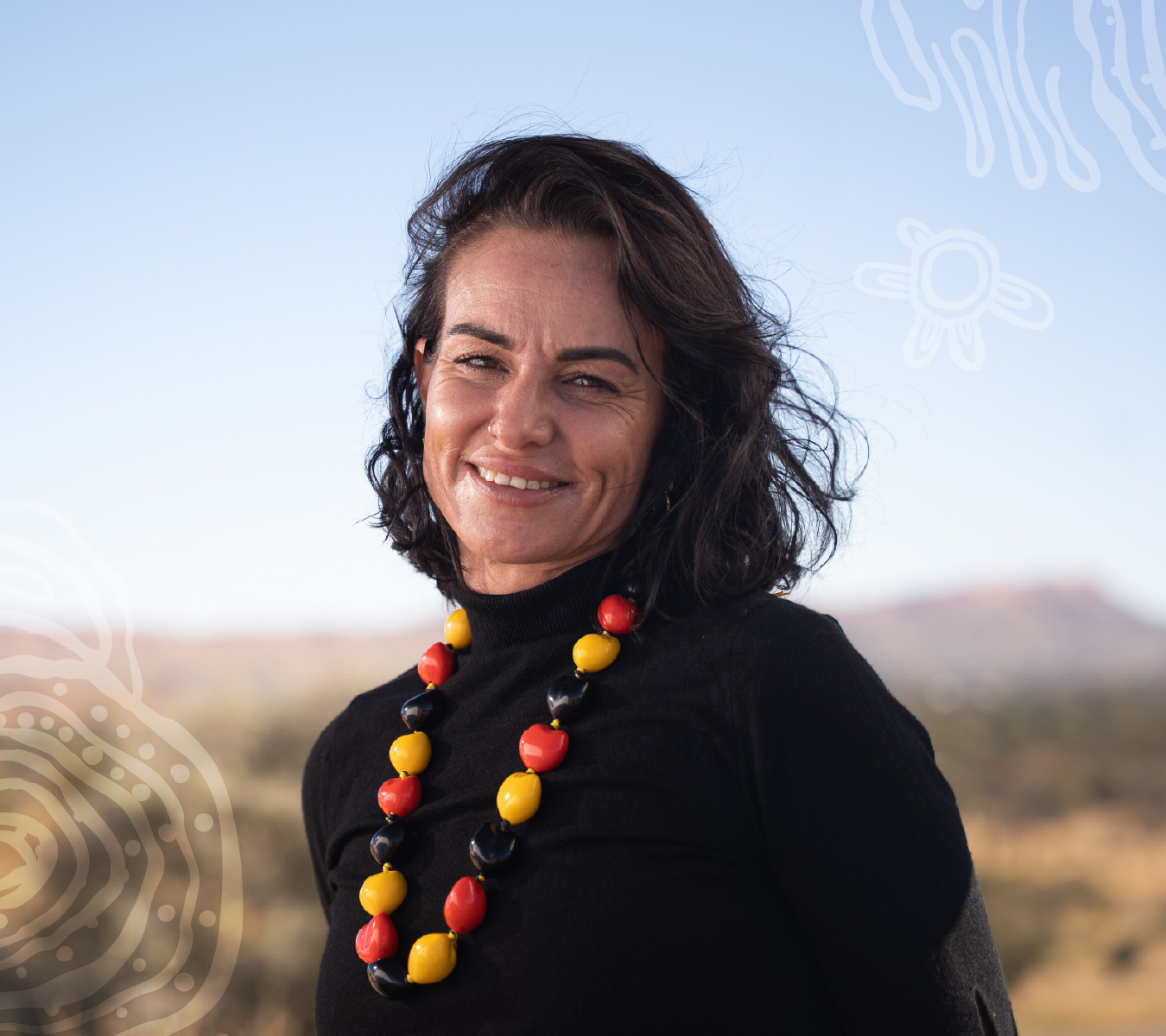
In this personal reflection, Holly Supple-Gurruwiwi, the Domestic, Family and Sexual Violence (DFSV) Commission's Lived Experience Advisory Council Co-Chair, recounts an unexpected conversation with a group of road workers working in remote NT. While much work is underway, the conversation underscored the need for Australia to build more 'community capability' by equipping ordinary people with the tools to safely recognise, interrupt and respond to early warning signs of violence.
Seat 20B: everybody’s business
Holly Supple-Gurruwiwi
I'd just sat down in Seat 20B and reached for my seatbelt when the young bloke in front of me turned around and said, "Be careful of the old bloke. He gets handsy. Don't fall asleep or you'll wake up with his hands..."
There were six of them travelling together. Construction workers who were part of a remote road gang working out in the desert from Alice Springs. Steel cap boots and red dirt still on them.
And apparently, of all the people on that plane, they had chosen me.
"Unless you both want to lose your hands, I suggest you turn around, face the front and shut up."
And they did.
Now I think it's safe to say I wasn't advocating for anybody to lose their hands. That response came from somewhere much more serious. It came from an Aboriginal woman living in the Northern Territory who understands what it means to navigate safety. Sometimes before we have time to find the perfect words, we make it very clear that you will not do that to me.
But as I sat there, I started thinking about why they had chosen me. Why did this young man look at the Aboriginal woman sitting behind him and think I might enjoy being included in a joke about being sexually touched while I slept?
Then I thought, Holly, you have two hours. You can stay angry or you can use them.
So, I started talking to them. Not lecturing them. Yarning with them.
I asked questions and explained why the comment mattered. Why sexualised comments about women aren't harmless just because somebody calls them a joke. Then I started asking about their world.
These men work together on a remote road gang. They spend long periods away from home in a mostly male environment. So, I asked what happens when somebody says something like that out there. Who laughs? Who stays quiet? Who knows it isn't right but doesn't want to make a big deal about it?
Do you actually know how to safely interrupt it?
None of them did.
That really struck me.
Here were six ordinary Australian men working together in a remote part of the country. They knew violence against women was wrong. But none of them had actually been taught what to do in those smaller moments that come before violence.
And somewhere in that conversation I realised we have missed a step.
We have spent years telling Australians that violence against women is everybody's business. I absolutely believe that. But if it is everybody's business, have we actually taught everybody how to do the business?
We tell people to speak up, but have we taught them what to say? We tell people not to be bystanders, but have we shown them how to safely interrupt? We tell people to look out for one another, but have we given them the confidence and practical skills to respond when something doesn't feel right?
These men didn't necessarily need another message telling them violence against women was wrong.
They needed skills.
So that is what we spent the next two hours talking about.
We talked about the simple things you can say when a mate crosses the line. "Mate, not funny." "Nah, leave her out of it." "We don't talk about women like that."
We talked about not laughing. Changing the conversation. Checking in with someone privately. Getting another mate involved if you don't feel comfortable doing it alone. And recognising when something has moved beyond a comment and somebody may need help.
By the end of the flight most of them genuinely appreciated what I had shared. They didn't agree with everything I said and they didn't have to. That wasn't the point.
The point was that we stayed in the conversation.
At one point I said to them, "we all have women in our lives, so this is literally everybody's business."
I've kept thinking about that conversation because it connects to something much bigger for me.
The national conversation
On 22 September 2026, Social Services Minister Tanya Plibersek spoke about the need to use Australia's big systems, including health, mental health, schools, TAFE, universities and early childhood settings, to identify domestic, family and sexual violence risk and intervene earlier.
In the same interview, the Minister was responding to DFSV Commissioner Micaela Cronin's call for a national approach to risk assessment so that health workers, teachers and ordinary people can raise a red flag when they need to.
I agree with that direction. But Seat 20B left me with another question.
What happens when an ordinary person notices the red flag but does not know what to do next?
That was exactly what I had sitting around me on that plane.
Six ordinary Australian men. They were not telling me they supported violence. But when I asked whether they actually knew how to safely interrupt the smaller behaviours that can sit around it, none of them did.
That is the gap I think we need to pay attention to.
Identification is important. Earlier intervention is important. Strong services and systems are essential. But there is another layer between community awareness and specialist response.
Community capability.
If we want ordinary Australians to notice earlier, speak up earlier and respond earlier, then we also need to equip them to do that safely.
I am not bringing this story to the Commission simply to point out another problem.
I have been working on a solution.
It is practical. It is designed for ordinary people, not specialists. It is about building the confidence and capability to recognise when something is not right and know what can safely happen next.
I am deliberately not setting out that model in this paper because it is work, I am developing separately.
But Seat 20B showed me why it is needed. And the national conversation happening right now tells me the timing matters.
The next opportunity for prevention might not happen inside a DFSV service. It might happen at smoko. In a ute.
At the pub. Around a family BBQ. Or on a remote road gang somewhere outside Alice Springs.
We have spent years telling Australians that violence against women is everybody's business.
Now we need to make sure people know what that means in practice.
Because next time something happens on that remote road gang, I won't be there.
But one of them will be.
Speaking from experience
Members of the Commission's Lived Experience Advisory Council are testament to how the perspectives of those lived experience are transforming efforts to end domestic, family and sexual violence.
Learn more about the Council